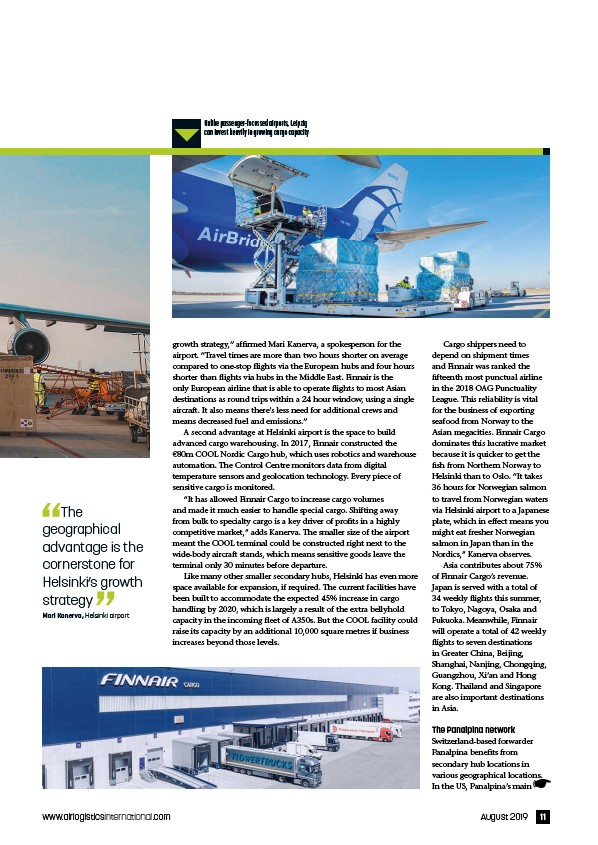
Unlike passenger-focussed airports, Leipzig
can invest heavily in growing cargo capacity
growth strategy,” affirmed Mari Kanerva, a spokesperson for the
airport. “Travel times are more than two hours shorter on average
compared to one-stop flights via the European hubs and four hours
shorter than flights via hubs in the Middle East. Finnair is the
only European airline that is able to operate flights to most Asian
destinations as round trips within a 24 hour window, using a single
aircraft. It also means there’s less need for additional crews and
means decreased fuel and emissions.”
A second advantage at Helsinki airport is the space to build
advanced cargo warehousing. In 2017, Finnair constructed the
€80m COOL Nordic Cargo hub, which uses robotics and warehouse
automation. The Control Centre monitors data from digital
temperature sensors and geolocation technology. Every piece of
sensitive cargo is monitored.
“It has allowed Finnair Cargo to increase cargo volumes
and made it much easier to handle special cargo. Shifting away
from bulk to specialty cargo is a key driver of profits in a highly
competitive market,” adds Kanerva. The smaller size of the airport
meant the COOL terminal could be constructed right next to the
wide-body aircraft stands, which means sensitive goods leave the
terminal only 30 minutes before departure.
Like many other smaller secondary hubs, Helsinki has even more
space available for expansion, if required. The current facilities have
been built to accommodate the expected 45% increase in cargo
handling by 2020, which is largely a result of the extra bellyhold
capacity in the incoming fleet of A350s. But the COOL facility could
raise its capacity by an additional 10,000 square metres if business
increases beyond those levels.
The
geographical
advantage is the
cornerstone for
Helsinki’s growth
strategy
Mari Kanerva, Helsinki airport
Cargo shippers need to
depend on shipment times
and Finnair was ranked the
fifteenth most punctual airline
in the 2018 OAG Punctuality
League. This reliability is vital
for the business of exporting
seafood from Norway to the
Asian megacities. Finnair Cargo
dominates this lucrative market
because it is quicker to get the
fish from Northern Norway to
Helsinki than to Oslo. “It takes
36 hours for Norwegian salmon
to travel from Norwegian waters
via Helsinki airport to a Japanese
plate, which in effect means you
might eat fresher Norwegian
salmon in Japan than in the
Nordics,” Kanerva observes.
Asia contributes about 75%
of Finnair Cargo’s revenue.
Japan is served with a total of
34 weekly flights this summer,
to Tokyo, Nagoya, Osaka and
Fukuoka. Meanwhile, Finnair
will operate a total of 42 weekly
flights to seven destinations
in Greater China, Beijing,
Shanghai, Nanjing, Chongqing,
Guangzhou, Xi’an and Hong
Kong. Thailand and Singapore
are also important destinations
in Asia.
The Panalpina network
Switzerland-based forwarder
Panalpina benefits from
secondary hub locations in
various geographical locations.
In the US, Panalpina’s main
www.airlogisticsinternational.com August 2019 11
/www.airlogisticsinternational.com